Zunyite

 Zunyite is a sorosilicate mineral, Al13Si5O20(OH,F)18Cl, composed of aluminium, silicon, hydrogen, chlorine, oxygen, and fluorine.

Zunyite
Zunyite-199876.jpg
Sharp, pyramids of brown-red zunyite from Silver City, Tintic District, East Tintic MountainsJuab County, Utah, US (size: 5.5 x 5 x 3.5 cm)
General
CategorySorosilicates
Formula
(repeating unit)
Al13Si5O20(OH,F)18Cl
Strunz classification9.BJ.55
Crystal systemIsometric
Crystal classHextetrahedral (43m)
H-M symbol: (43m)
Space groupF43m
Unit cella = 13.8654 - 13.8882 Å; Z = 4
Identification
ColorGrayish white, flesh-red; colorless in thin section
Crystal habitCrystalline - occurs as well-formed fine sized crystals
TwinningOn {111}, contact and penetration
CleavageGood on {111}
FractureUneven
TenacityBrittle
Mohs scale hardness7
LusterVitreous
StreakWhite
DiaphaneityTransparent to translucent with inclusions
Specific gravity2.874(5) (meas.) 2.87 - 2.90 (calc.)
Optical propertiesIsotropic
Refractive indexn = 1.592 - 1.600
Other characteristicsMay fluoresce red under UV
References[1][2][3]

OccurrenceEdit

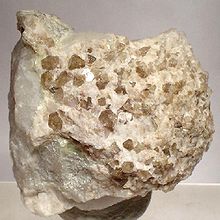
Glassy, translucent, gray-tan, pseudohexagonal zunyite crystals on a milky quartz matrix. From the Big Bertha Mine, Dome Rock MountainsLa Paz County, Arizona (size: 3.3 x 3.2 x 2.8 cm))

Zunyite occurs in highly aluminous shales and hydrothermally altered volcanic rocks. It occurs in association with pyrophyllitekaolinitealunitediasporerutilepyritehematite and quartz.[1]

It was discovered in 1884, and named for its discovery site, the Zuni mine in the Silverton District, San Juan County, Colorado.


This article uses material from the Wikipedia article
 Metasyntactic variable, which is released under the 
Creative Commons
Attribution-ShareAlike 3.0 Unported License
.