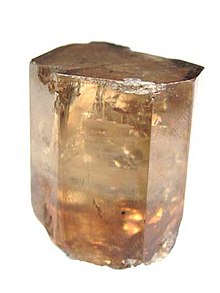
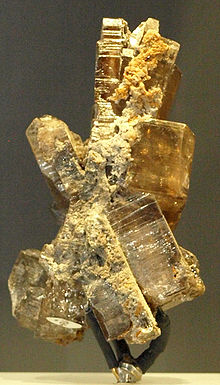
Phosgenite is a rare mineral consisting of lead chlorocarbonate, (PbCl)2CO3. The tetragonal crystals are prismatic or tabular in habit: they are usually colorless and transparent, and have a brilliant adamantine lustre. Sometimes the crystals have a curious helical twist about the tetrad or principal axis. The hardness is 3 and the specific gravity 6.3. The mineral is rather sectile, and consequently was earlier known as corneous lead, (German Hornblei).[5]
Name and occurrence
The name phosgenite was given by August Breithaupt in 1820, from phosgene, carbon oxychloride, because the mineral contains the elements carbon, oxygen and chlorine.[5]
It was found associated with anglesite and matlockite in cavities within altered galena in a lead mine at Cromford, near Matlock: hence its common name cromfordite.[6] Crystals are also found in galena at Monteponi near Iglesias in Sardinia, and near Dundas in Tasmania.[5] It has also been reported from Laurium, Greece; Tarnowitz, Poland; the Altai district, Siberia; the Touissit mine, near Oujda, Morocco; Sidi Amor ben Salem, Tunisia; Tsumeb, Namibia; Broken Hill, New South Wales; and Boleo, near Santa Rosalia, Baja California. In the US it has been reported from the Terrible mine, Custer County, Colorado; the Stevenson-Bennett mine, Organ Mountains, Doña Ana County, New Mexico; and the Mammoth mine, Tiger, Pinal County, Arizona.[2]
Crystals of phosgenite, and also of the corresponding bromine compound PbBr2CO3, have been prepared artificially.
| This article uses material from the Wikipedia article Metasyntactic variable, which is released under the Creative Commons Attribution-ShareAlike 3.0 Unported License. |