Rheniite is a very rare rhenium sulfide mineral (ReS2). It forms metallic, silver grey platey crystals in the triclinic - pinacoidal class.[1] It has a specific gravity of 7.5.
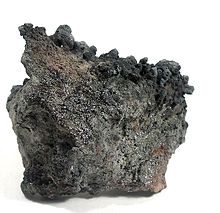
It was discovered at the Kudriavy Volcano, Iturup Island in the Kurile Islands, Russia[3] and approved in 2004. It is found in active hot fumaroles on the volcano.
Rheniite is the first mineral of the element rhenium to be found. The second known approved rhenium mineral is tarkianite, being also a sulfide. Almost all commercially mined rhenium is retrieved as a by-product of molybdenum mining as rhenium occurs in amounts up to 0.2% in the mineral molybdenite. A discredited rhenium sulfide known as zappinite does not appear to be valid.
Rheniite has also been reported in the Pagoni Rachi Mo–Cu–Te–Ag–Au deposit in northeastern Greece where it occurs with molybdenite in quartz veins associated with an epithermal system in a dacite porphyry.
| This article uses material from the Wikipedia article Metasyntactic variable, which is released under the Creative Commons Attribution-ShareAlike 3.0 Unported License. |