Serandite[3] is a mineral with formula Na(Mn2+,Ca)2Si3O8(OH). The mineral was discovered in Guinea in 1931 and named for J. M. Sérand. Serandite is generally red, brown, black or colorless. The correct name lacks an accent.[4]
Description
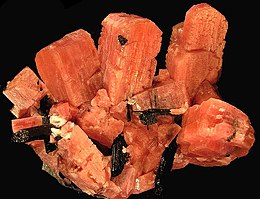
Serandite is transparent to translucent and is normally salmon-pink, light pink, rose-red, orange, brown, black, or colorless; in thin section, it is colorless.[1] Octahedrally bonded Mn(II) is the primary contributor to the mineral's pink colors.[5]
Crystals of the mineral can be prismatic to acicular and elongated along [010], bladed, blocky, or tabular and flattened on {100}, occur as a radiating aggregate, or have massive habit.[1] Sérandite is a member of the wollastonite group and is the manganese analogue of pectolite.[2] It is sometimes used as a gemstone.[6]
History
Serandite was discovered on Rouma Island, part of the Los Islands in Guinea.[2] The mineral was described by À. Lacroix in the journal Comptes rendus hebdomadaires des séances de l'Académie des Sciences.[7] He named it sérandite in honor of J.M. Sérand, a mineral collector who helped in the collection of the mineral.[2]
Occurrence and distribution
Serandite has been found in Australia, Brazil, Canada, Guinea, Italy, Japan, Namibia, Norway, Russia, South Africa, and the United States.[2] The type material is held at the National Museum of Natural History in Washington, D.C.[1]
At Mont Saint-Hilaire, Quebec, serandite occurs in sodalite xenoliths and pegmatites cutting syenites within an intrusive alkalic gabbro-syenite complex. In Point of Rocks, New Mexico, it occurs in vugs in phonolite. At the Tumannoe deposit in Russia, serandite occurs in a manganese rich deposit associated with volcanic rocks and terrigenous (non-marine) sediments which has been altered by contact metamorphism.[1]
Serandite has been found in association with aegirine, analcime, arfvedsonite, astrophyllite, eudialyte, fluorite, leucophanite, mangan-neptunite, microcline, nepheline, sodalite, and villiaumite.
| This article uses material from the Wikipedia article Metasyntactic variable, which is released under the Creative Commons Attribution-ShareAlike 3.0 Unported License. |