Sonolite is a mineral with formula Mn9(SiO4)4(OH,F)2. The mineral was discovered in 1960 in the Sono mine in Kyoto Prefecture, Japan. In 1963, it was identified as a new mineral and named after the Sono mine.
Description
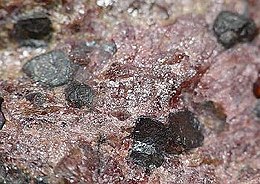
Sonolite is transparent to translucent[2] and is red-orange, pinkish brown to dark brown in color and colorless in thin sections. The mineral has a granular habit or occurs as prismatic to anhedral crystals up to 2.5 cm (0.98 in).[1] Sonolite is the manganese analogue of clinohumite,[4] a dimorph of jerrygibbsite,[1] and a member of the humite group.[3]
The mineral occurs in metamorphosed manganese-rich deposits. Sonolite has been found in association with calcite, chlorite, franklinite, galaxite, manganosite, pyrochroite, rhodochrosite, tephroite, willemite, and zincite.[1]
History
In 1960, Mayumi Yoshinaga was investigating alleghanyite and other manganese orthosilicates in Japan. He discovered a dull, red-brown mineral on the first level ore body of the Sono Mine, and later from a number of other sites.[4] Using samples from ten locations in Japan and one in Taiwan, the mineral was described in 1963 and identified as a new mineral species.[5] It was named sonolite after the mine in which it was first found and the name was approved by the International Mineralogical Association.[3][4]
Distribution
As of 2012, sonolite has been found in Austria, France, Japan, Kyrgyzstan, Romania, Russia, Sweden, Switzerland, Taiwan, and the United States.[3] The type material is held at Harvard University in Cambridge, Massachusetts, US.
| This article uses material from the Wikipedia article Metasyntactic variable, which is released under the Creative Commons Attribution-ShareAlike 3.0 Unported License. |