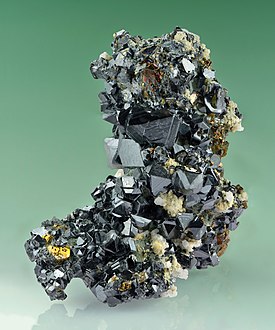
Sphalerite ((Zn, Fe)S) is a mineral that is the chief ore of zinc. It consists largely of zinc sulfide in crystalline form but almost always contains variable iron. When iron content is high, sphalerite is an opaque black variety called marmatite.[4] Sphalerite is usually found in association with the minerals galena, pyrite (and other sulfides), calcite, dolomite, and fluorite.[5] Miners have also been known to refer to sphalerite as zinc blende, black-jack and ruby jack.[6]

Chemistry

The mineral crystallizes in the cubic crystal system.[7] Like other minerals with a cubic crystal structure, sphalerite may show a tetrahedral crystal habit. In the crystal structure, zinc and sulfur atoms are tetrahedrally coordinated. The structure is closely related to the structure of diamond. The hexagonal analog is known as the wurtzite structure. The lattice constant for zinc sulfide in the zinc blende crystal structure is 0.541 nm.[8]
All natural sphalerites contain concentrations of various impurities, which generally substitute for the zinc position in the lattice. The most common impurities are Cd and Mn, but Ga, Ge and In may also be present in relatively high concentrations (hundreds to thousands of ppm).[9] The abundances of these elements are controlled by the conditions under which the sphalerite formed; formation temperature and fluid composition are important controls.[9]
Varieties
Sphalerite's color is yellow, brown, or gray to gray-black, and it may be shiny or dull. Its luster is adamantine, resinous to submetallic for high iron varieties. It has a yellow or light brown streak, a Mohs hardness of 3.5–4, and a specific gravity of 3.9–4.1.[7] Some specimens have a red iridescence within the gray-black crystals; these are called "ruby sphalerite". The pale yellow and red varieties have very little iron and are translucent. The darker, more opaque varieties contain more iron.[7] Some specimens are also fluorescent in ultraviolet light.

The refractive index of sphalerite (as measured via sodium light, average wavelength 589.3 nm) is 2.37. Sphalerite crystallizes in the isometric crystal system and possesses perfect dodecahedral cleavage.
Gemmy, pale specimens from Franklin, New Jersey (see Franklin Furnace), are highly fluorescent orange and/or blue under longwave ultraviolet light and are known as cleiophane, an almost pure ZnS variety.[10]
Occurrence
Sphalerite is the major ore of zinc and is found in thousands of locations worldwide, on every continent.[6][2]
Sources of high quality crystals include:[3]
Economic importance
Sphalerite is the most important ore of zinc. Around 95% of all primary zinc is extracted from sphalerite ore. However, due to its variable trace element content, sphalerite is also an important source of several other elements such as cadmium,[11] gallium[12] germanium,[13] and indium.[14]
Gemstone use
Crystals of suitable size and transparency have been fashioned into gemstones, usually featuring the brilliant cut to best display sphalerite's high dispersion of 0.156 (B-G interval), over three times that of diamond. Freshly cut gems have an adamantine luster. Owing to their softness and fragility the gems are often left unset as collector's or museum pieces (although some have been set into pendants). Gem-quality material is usually a yellowish to honey brown, red to orange, or green.[5]
Gallery


| This article uses material from the Wikipedia article Metasyntactic variable, which is released under the Creative Commons Attribution-ShareAlike 3.0 Unported License. |