Spodumene is a pyroxene mineral consisting of lithium aluminium inosilicate, LiAl(SiO3)2, and is a source of lithium. It occurs as colorless to yellowish, purplish, or lilac kunzite (see below), yellowish-green or emerald-green hiddenite, prismatic crystals, often of great size. Single crystals of 14.3 m (47 ft) in size are reported from the Black Hills of South Dakota, United States.[5][6]
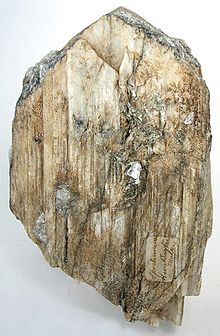
The naturally occurring low-temperature form α-spodumene is in the monoclinic system whereas the high-temperature β-spodumene crystallizes in the tetragonal system. α-spodumene converts to β-spodumene at temperatures above 900 °C.[4] Crystals are typically heavily striated parallel to the principal axis. Crystal faces are often etched and pitted with triangular markings.
Discovery and occurrence
Spodumene was first described in 1800 for an occurrence in the type locality in Utö, Södermanland, Sweden. It was discovered by Brazilian naturalist Jose Bonifacio de Andrada e Silva. The name is derived from the Greek spodumenos (σποδούμενος), meaning "burnt to ashes," owing to the opaque, ash-grey appearance of material refined for use in industry.[1]
Spodumene occurs in lithium-rich granite pegmatites and aplites. Associated minerals include: quartz, albite, petalite, eucryptite, lepidolite and beryl.[2]
Transparent material has long been used as a gemstone with varieties kunzite and hiddenite noted for their strong pleochroism. Source localities include Afghanistan, Australia, Brazil, Madagascar, Pakistan, Québec in Canada and North Carolina, California in the US.
Economic importance
Spodumene is an important source of lithium for use in ceramics, mobile phone and automotive batteries, medicine, Pyroceram and as a fluxing agent. Lithium is extracted from spodumene by fusing in acid after roasting to convert it to the more reactive β-spodumene.
In 2016, the price was forecast to be $500-600/ton for years to come.[7] However, price spiked above $800 in January 2018, and production increased more than consumption, reducing price to $400 in September 2020.[8][9]
World production of lithium via spodumene was around 80,000 metric tonnes per annum in 2018, primarily from the Greenbushes pegmatite of Western Australia and from some Chinese and Chilean sources. The Talison mine in Greenbushes, Western Australia is reported to be the largest and to have the highest grade of ore at 2.4% Li2O (2012 figures).[10]
In 2020 Australia expanded spodumene mining to become the leading lithium producing country in the world[11] (see table below).[citation needed]
Two advantages of spodumene compared to brine are:
- the purity of the lithium carbonate it can produce. The battery industry requires 99.5% pure lithium carbonate. The nature of the impurities is important: for example iron or magnesium (which tends to occur more in brine make it a less attractive source.
- inception time for a plant: once an ore processing plant is complete it can produce lithium carbonate within days whereas evaporation of brine to usable concentrations in open evaporation fans can take 18 months to 3 years, depending on evaporation rates and initial concentration.
Gemstone varieties
Hiddenite
Hiddenite is a pale, emerald-green gem variety first reported from Alexander County, North Carolina, US. It was named in honor of William Earl Hidden (16 February 1853 - 12 June 1918), mining engineer, mineral collector, and mineral dealer.
This emerald green variety of spodumene is colored by chromium, just like emeralds. Not all green spodumene is colored with chromium, which tend to have a lighter color, and therefore are not true hiddenite.[clarification needed]
Kunzite
Kunzite is a pink to lilac colored gemstone, a variety of spodumene with the color coming from minor to trace amounts of manganese. Some (but not all) kunzite used for gemstones has been heated to enhance its color. It is also frequently irradiated to enhance the color.
Kunzite was discovered in 1902, and was named after George Frederick Kunz, Tiffany & Co's chief jeweler at the time, and a noted mineralogist. It has been found in Brazil, US, Canada, CIS, Mexico, Sweden, Western Australia, Afghanistan and Pakistan.
One notable example of kunzite used in jewellery is in the Russian Palmette tiara and necklace worn by the Duchess of Gloucester.[12]


Triphane
Triphane is a synonym of spodumene, but also used for colourless or yellowish varieties.
| This article uses material from the Wikipedia article Metasyntactic variable, which is released under the Creative Commons Attribution-ShareAlike 3.0 Unported License. |