Terlinguaite is the naturally occurring mineral with formula Hg2ClO. It is formed by the weathering of other mercury-containing minerals. It was discovered in 1900 in the Terlingua District of Brewster County, Texas, for which it is named.[4] Its color is yellow, greenish yellow, brown, or olive green.
| Terlinguaite |
|---|
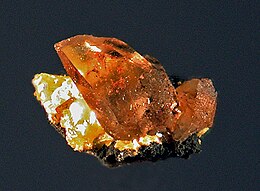 Terlinguaite, collected from Mariposa Mine, Terlingua District, Brewster County, Texas, United States |
| General |
|---|
| Category | Halide mineral |
|---|
Formula
(repeating unit) | Hg2ClO |
|---|
| Strunz classification | 3.DD.20 |
|---|
| Crystal system | Monoclinic |
|---|
| Crystal class | Prismatic (2/m)
(same H-M symbol) |
|---|
| Space group | C2/c |
|---|
| Unit cell | a = 19.51 Å, b = 5.91 Å
c = 9.47 Å; β = 143.81°; Z = 4 |
|---|
| Identification |
|---|
| Color | Sulfur-yellow, greenish yellow, brown |
|---|
| Crystal habit | Aggregates of equant to elongated crystals, powdery, massive |
|---|
| Cleavage | Perfect on [101] |
|---|
| Tenacity | Brittle |
|---|
| Mohs scale hardness | 2.5 |
|---|
| Luster | Brilliant adamantine |
|---|
| Streak | Lemon-yellow, turning olive-green |
|---|
| Diaphaneity | Transparent to translucent |
|---|
| Specific gravity | 9.22 |
|---|
| Optical properties | Biaxial (-) |
|---|
| Refractive index | nα = 2.350 nβ = 2.640 nγ = 2.660 |
|---|
| Birefringence | δ = 0.310 |
|---|
| Pleochroism | Weak, green and yellow |
|---|
| 2V angle | Measured: 20° |
|---|
| Alters to | turns olive-green on exposure to light |
|---|
| References | [1][2][3] |
|---|