Tinaksite (K2Na(Ca,Mn2+)2Ti[O|Si7O18(OH)])[2] is a mineral found in northern Russia. Tinaksite can be grayish-white, yellowish, orange, or brown,[1] and it is often found in charoite.[4] Its name is derived from its composition: titanium (Ti), sodium (Na) potassium (K) and silicon (Si). International Mineralogical Association first recognized tinaksite as a mineral in 1965.
| Tinaksite |
|---|
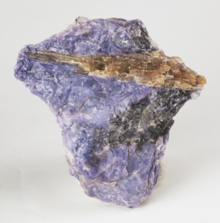 Tinaksite (brown) and associated charoite (lilac). |
| General |
|---|
| Category | Silicate mineral |
|---|
Formula
(repeating unit) | K2Na(Ca,Mn2+)2Ti[O|Si7O18(OH)] |
|---|
| Strunz classification | 9.DG.75 |
|---|
| Crystal system | Triclinic |
|---|
| Crystal class | Pinacoidal (1)
(same H-M symbol) |
|---|
| Space group | P1 |
|---|
| Identification |
|---|
| Color | Pink, pale yellow, light brown |
|---|
| Crystal habit | Fibrous, crystalline or prismatic, crystalline, or radial, crystalline |
|---|
| Cleavage | Perfect in one direction, indistinct in one direction |
|---|
| Mohs scale hardness | 6 |
|---|
| Luster | Vitreous to glassy |
|---|
| Streak | White |
|---|
| Diaphaneity | Transparent to translucent |
|---|
| Specific gravity | 2.82 |
|---|
| Optical properties | Biaxial (+) |
|---|
| Refractive index | nα = 1.593 nβ = 1.621 nγ = 1.666 |
|---|
| Birefringence | δ = 0.073 |
|---|
| References | [1][2][3] |
| |
|---|
