Vauquelinite

 Vauquelinite is a complex mineral with the formula CuPb2(CrO4)(PO4)(OH) making it a combined chromate and phosphate of copper and lead. It forms a series with the arsenate mineral fornacite.[1]
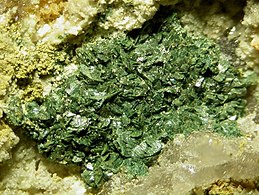
Vauquelinite
Vauquelinite-120513.jpg
Vauquelinite
General
CategoryPhosphate mineral
Formula
(repeating unit)
CuPb2(CrO4)(PO4)(OH)
Strunz classification7.FC.05
Crystal systemMonoclinic
Crystal classPrismatic (2/m)
(same H-M symbol)
Space groupP21/n
Unit cella = 13.754(5) Å, b = 5.806(6) Å
c = 9.563(3) Å; β = 94.55°; Z = 4
Identification
ColorOlive-green, apple-green, brown to nearly black
Crystal habitIrregular wedge shaped crystals, mammillary, reniform masses
TwinningPresent on {102}
CleavageIndistinct
FractureIrregular
TenacityBrittle
Mohs scale hardness2.5 - 3
LusterAdamantine, resinous
StreakGreenish or brownish
DiaphaneityTranslucent
Specific gravity6.16
Optical propertiesBiaxial (-)
Refractive indexnα = 2.110 nβ = 2.220 nγ = 2.220
Birefringenceδ = 0.110
PleochroismX = Light green, Y = Light brown, Z = Light brown
2V angleNear zero
References

It was first described in 1818 in the Beryozovskoye depositUralsRussia, and named for Louis Vauquelin (1763–1829), a French chemist.[1] It occurs in oxidized hydrothermal ore deposits and is associated with crocoitepyromorphitemimetitecerussitebeudantite and duftite at the type locality in Russia.


This article uses material from the Wikipedia article
 Metasyntactic variable, which is released under the 
Creative Commons
Attribution-ShareAlike 3.0 Unported License
.