Volborthite

 Volborthite is a mineral containing copper and vanadium, with the formula Cu3V2O7(OH)2·2H2O. Found originally in 1838 in the Urals, it was first named knaufite but was later changed to volborthite for Alexander von Volborth (1800–1876), a Russian paleontologist.[4]
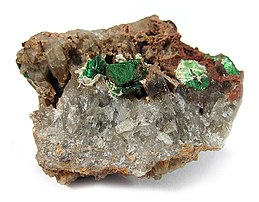
Volborthite
Volborthite-65625.jpg
Neon green crystals of volborthite are nestled in a vug in the matrix
General
CategoryPolyvanadate minerals
Formula
(repeating unit)
Cu3V2O7(OH)2·2H2O
Strunz classification8.FD.05
Dana classification40.03.10.01
Crystal systemMonoclinic
Crystal classPrismatic (2/m)
(same H-M symbol)
Space groupC2/m
Unit cella = 10.610(2) Å, b = 5.866(1) Å
c = 7.208(1) Å; β = 95.04(2)°; Z = 2
Identification
ColorOlive-green, yellow-green; green to yellow-green in transmitted light
Crystal habitAggregates of scaly crystals, rosettes
CleavagePerfect
Mohs scale hardness3 12
LusterVitreous, waxy, greasy, pearly
Streaklight green
DiaphaneityTranslucent
Specific gravity3.5 - 3.8
Optical propertiesBiaxial (+/-)
Refractive indexnα = 1.793 nβ = 1.801 nγ = 1.816
Birefringenceδ = 0.023
PleochroismWeak
2V angleMeasured: 63° to 83°
DispersionTranslucent to Subtranslucent
Ultraviolet fluorescenceNon-fluorescent
SolubilitySoluble in acids
References[1][2][3]

Tangeite (synonym: calciovolborthite), CaCuVO4(OH), is closely related.

OccurrenceEdit

Volborthite was first described in 1837 for an occurrence in the Sofronovskii Mine, Yugovskii ZavodPermPermskaya Oblast, Middle Urals, Russia.[2]

It occurs as an uncommon oxidation mineral in vanadium bearing hydrothermal copper ores. It is associated with brochantitemalachiteatacamitetangeitechrysocollabaryte and gypsum.


This article uses material from the Wikipedia article
 Metasyntactic variable, which is released under the 
Creative Commons
Attribution-ShareAlike 3.0 Unported License
.