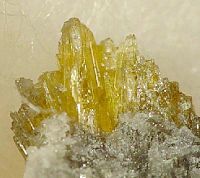
Warikahnite is a rare zinc arsenate mineral of the triclinic crystal system with Hermann- Mauguin notation 1, belonging to the space group P1.[5] It occurs in the Tsumeb mine in Namibia on corroded tennantite in the second oxidation zone under hydrothermal conditions in a dolomite-hosted polymetallic ore deposit.[4][6] It is associated with adamite, stranskiite, koritnigite, claudetite, tsumcorite, and ludlockite. The origin of discovery was in a dolosmite ore formation within an oxidized hydrothermal zone, in the E9 pillar, 31st level of the Tsumeb Mine in Namibia, Southwest Africa.[1][4] It has also been found at Lavrion, Greece and Plaka, Greece as microscopic white needles.[5]
Discovery

Warikahnite was discovered by Clive Queit[5] at Tsumeb mine and was first described in 1979 by Keller, Hess, and Dunn.[1][4] The name "warikahnite" honors Walter Richard Kahn, who was born in 1911. He was from Bad Bayersoien, Germany, and he was a dealer and collector that specialized in Tsumeb minerals. He was honored due to his support of research into rare secondary minerals.[1] The type material is located at the University of Stuttgart, the Smithsonian Institution, and Harvard University.[4][5]
Physical properties
Warikahnite has perfect cleavage on the c-axis {001}; and good cleavage on both the a- and b-axes ({100} and {010}).[4] It has bladed subhedral crystals up to 3 x .5 x .5 mm, elongated on {100} and flattened on {010}, with a hardness of approximately 2 as presented in table two. Its specific gravity is 4.24 and it exhibits a colorless to pale yellow hue, along with a white streak and vitreous luster.[5] This triclinic 1 specimen classified under the space group P1 features striated crystals up to two centimetres in radial to subparallel aggregates.[6] The Handbook of Mineralogy further states the cell dimensions of biaxial Warikahnite to be calculated as a = 6.710(1) Å, b = 8.989(2) Å, and c = 14.533(2) Å, with unit cell volume as 788.58 Å.[5]
Crystal structure
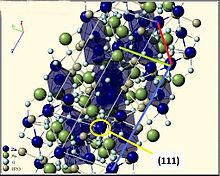
The crystal structure of Warikahnite, determined from diffractometer data, contained six various coordination polyhedra of zinc with components of As, O, and H₂O; with the coordination numbers six, five, and four; and with five different combinations of ligand.[7] Also noted in the “Die Kristallstruktur von Warikahnit” article, is that the hydrogen bonds are discussed appertaining to both charge balance and infrared spectra. Recent data shows the Gladstone-Dale relation compatibility of Warikahnite is ranked as superior (-0.010).[8]
Chemical composition
Warikahnite has the chemical formula Zn3(AsO4)2•2H2O. Along with arsenate ions (AsO₄)3−, the infrared spectrum revealed H₂O .[4] These water molecules present in the warikahnite sample were determined by thermo gravimetric analysis, and lost at 365°C. Both H₂O and (AsO₄)3− readily dissolved when hot hydrochloric acid (HCL) or nitric acid (HNO₃) were added to the specimen.[9] After a microprobe analysis, the weight percent oxides were calculated as follows in the table directly below.[4]
Geologic occurrence
Warikahnite’s only known localities to date are the Tsumeb Mine in Namibia, South West Africa; and Plaka and Lavrion, Greece.[5] The first discovery of this type specimen in the mine was found with white koritnigite, blue stranskiite, pale to emerald-green cuprian adamite, crystals of helmutwinklerite, and white corroded crystals of claudetite, ludlockite, tsumcorite, and lavendulan; while the second acquisition was only linked to quartz.
| This article uses material from the Wikipedia article Metasyntactic variable, which is released under the Creative Commons Attribution-ShareAlike 3.0 Unported License. |